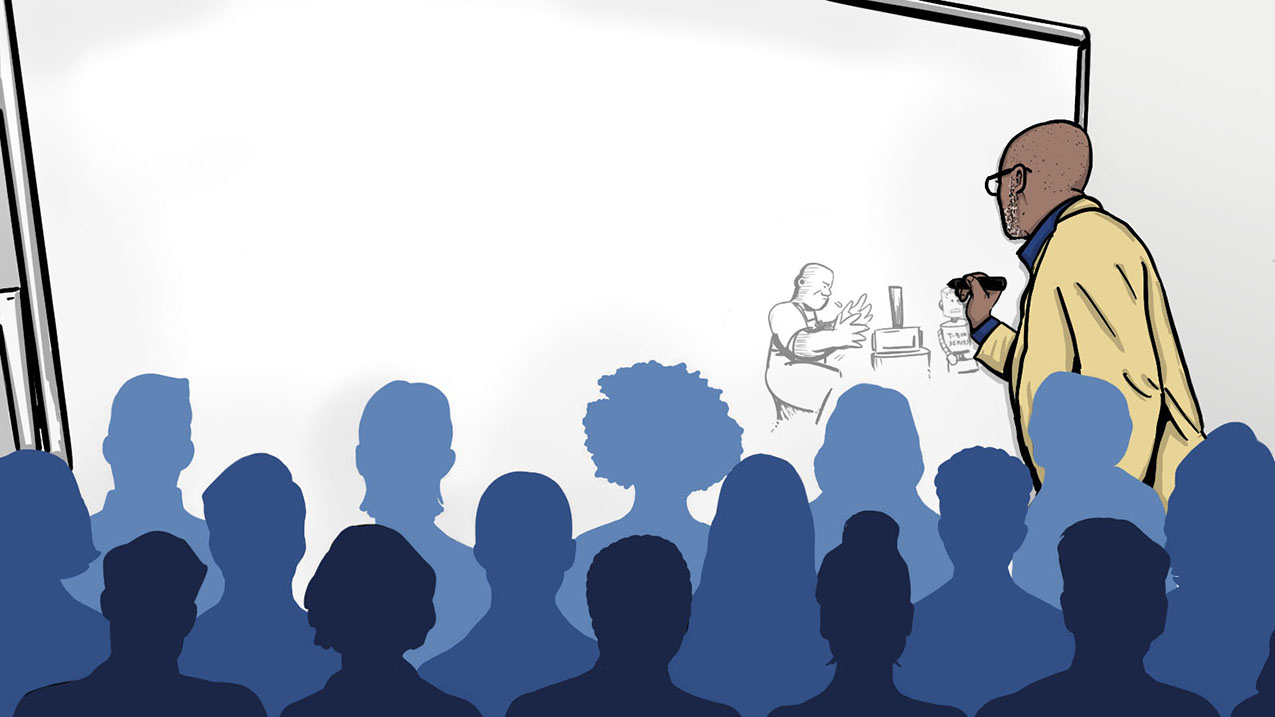
Do you believe we humans are special? Do you feel a major component of that specialness is our ability to tell stories? And do you believe that when those stories are shared with candor and authenticity, and depicted with creativity by master storytellers, we can learn from them and be inspired in ways that keep our culture alive and moving forward? I do. It’s why, after years of graphic recording with the small but hugely influential consulting firm MG Taylor Corporation- work that helped us partner with Ernst & Young to create the ASE (Accelerated Solutions Environment)- I named my entrepreneurial venture Griot’s Eye in 1998, after the West African storytelling tradition.

The personality-driven era of scribing, visual storytelling, and the dawn of a new era
In 1998, businesses didn’t throw around the term “storytelling” much beyond its traditional definition in organizational settings; the corporate jargon/buzzword status it has today was still years away. In fact, when I told a colleague the name of my new entrepreneurial venture and explained its origin, they asked how I thought graphic recording was storytelling. It seemed obvious to me: marrying pictures and words in real time to move, remind, illuminate, and engage—listening for the facts and weaving them into a visual narrative. Matt and Gail Taylor’s DesignShop process (the “M” and the “G” in MG Taylor), where I matriculated (fancy word alert!) as a knowledge worker and graphic facilitator, was a lot of things: idea factory, group genius incubator, organizational theater, but it was also a place for sharing and discussing stories with candor and authenticity so that we could better understand each other’s experiences. The work we did at MG Taylor, shepherding the creation of Ernst & Young’s ASE (now Capgemini’s ASE), helped to birth some of the finest graphic facilitators working worldwide today, whether directly or indirectly. And each one of those visual notetakers/graphic recorders/scribes is a storyteller, in essence a (mostly) silent griot —because even though our main focus is listening rather than inserting ourselves into the dialogues we capture, our work not only visually speaks volumes to groups but reflects our individual personalities and creativity — we let the images do the talking, poetry-making, even singing. MG Taylor helped open the door to what I coined “the personality-driven era” of graphic recording in my essay “A Brief History of Graphic Recording (the MG Taylor Branch".
The personality-driven era of scribing coincides with the onset of the digital era and the rise of the Internet. Now we are in the midst of a new age dawning (no, not Aquarius, that’s been put on hold due to the thrashing of late-stage capitalism) — the age of Artificial Intelligence. Many media professionals, futurists, online content creators, and just about everyone else have been discussing and debating artificial intelligence. Zealots believe it is our cure-all savior, while doomsday prognosticators think it will lead to our downfall. Many people fear it will replace us rather than serve as a tool to augment our work. I will be straight up and say that I lean more towards the agnostic than the AI Kool-Aid sippers. I have serious misgivings about the environmental impact of hyperscale data centers and the often-unreliable information it produces.

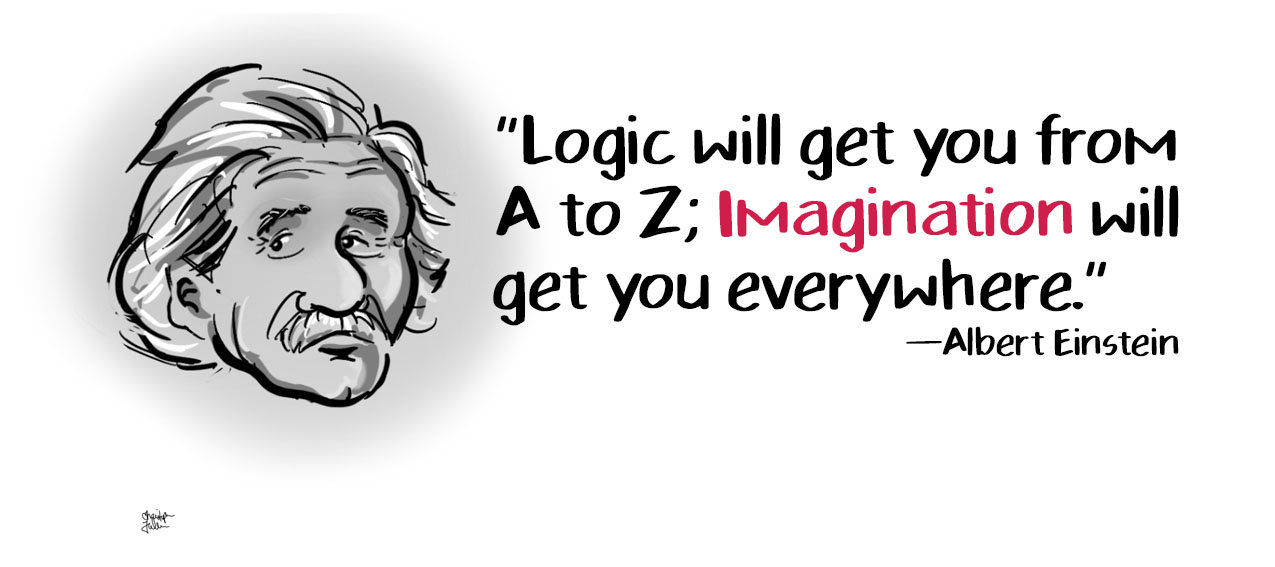
The type of AI I address in this Insight is generative, not predictive. As I understand it, predictive AI is pattern-finding used by researchers, engineers, scientists, and others to help us discover breakthroughs in healthcare, meteorology, astrophysics, logistics optimization, and a bunch of other stuff built on structured data and statistical analysis — basically math and facts. I am generally in favor of stuff that might help us cure disease or discover things about our universe. Generative AI, on the other hand, includes large language models and chatbots (ChatGPT, Claude, OpenAI, Anthropic, etc.) and image and A/V generators. Dr. Emily M. Bender, a professor of linguistics at the University of Washington, describes LLMs as “stochastic parrots” — meaning, rather than reasoning or thinking, they predict what’s next based on pattern recognition and logical sequencing. Generative AI’s ability to use pattern recognition and logical sequencing to mimic human language without understanding its meaning is why Dr. Bender and others question its “intelligence” and call it a “stochastic parrot.” If you have ever been the victim of an AI hallucination (check √), written a sentence or paragraph and dropped it into an LLM to “second-eye” your spelling and grammar, only for it to offer an alternative that completely removes your voice and distorts its meaning (check √), or seen a clip where ChatGPT repeatedly and confidently states the wrong number of letters in a simple word (check √), then you understand this. It's because it can’t truly be imaginative and lacks the background of human experience. And imagination, that unique human spark of creativity taken from authentic human experiences, is the essential ingredient that generative AI does not have. Einstein states that “Logic will get you from A to Z; imagination will get you everywhere." That is why I value conversations with my friends in Italy more than the Italian language practice sessions I have done with ChatGPT. Because of the extensive work I did for Italy’s UniCredit Bank’s UniManagement program and later working with the incredible Italian facilitation firm Architects of Group Genius, based in Milan, I have many Italian friends (“ciao, amici!”). ChatGPT has been a convenient way to continue practicing. Still, no matter how good it is, it can’t equal the connection I have with my friends in Italy and the learning I get from them. For me, AI is a tool, but it’s no replacement, as it cannot match the unpredictability of imagination and the authenticity of human interaction.
Keeping It real: The power of authentic performances
That is why human craftsmanship and artistry will always have irreplaceable value, even as generative AI advances. Even though genAI is evolving past its “slop phase” and, without scrutiny, is indistinguishable from a lot of human creative acts (we’ve all been fooled at first glance watching or listening to something created by genAI), people will always have a desire and need to participate in and be in the presence of authentically crafted human creativity and expression. Even if the authenticity people yearn for is sometimes a mere illusion, they still want to buy into the idea that they’re experiencing something all-natural and unadulterated. That’s part of the reason we enjoy watching human endeavors like sporting competitions, music concerts, or live dance. It is also why we are so disappointed when we discover our favorite athlete used performance-enhancing drugs or cheated in a race, or a singer was caught lip-syncing, because the illusion of authenticity was shattered.
In-person graphic recording and its performance allure
But few activities match the experience of seeing an authentic live performance. I rarely write much about the performance aspects of in-person graphic recording. But I would be disingenuous if I didn't acknowledge live “performing” as a huge part of the craft's appeal. The reason I downplay it in many of these Insights that I write is that I do not want less experienced scribes to think that it is their primary mission, lest they lose the meaning of the story while they’re trying to be a “rock star scribe.” As the person who scribed those critical MG Taylor events that helped convince EY to license our methodology and take the craft worldwide, I know how much the live-performance aspect of graphic recording contributed to its popularity. I truly learned the value of graphic recording’s performance allure from my old boss, Matt Taylor, after we secured the Ernst & Young contract. In a celebratory mood, Matt and our head of environment and furniture design, Bill Blackburn, took me out for lunch at our favorite spot in Hilton Head, South Carolina: Truffles Cafe. As we were celebrating the fresh new EY contract, making plans to expand (we were opening a store called “Knowhere” that we had hired Kelvy Bird to manage, along with Gail’s son, Todd) and enjoying a beer (or two), Matt toasted me and declared, “I should’ve hired you a long time ago, because the only thing I’ve done since hiring you is make money!”
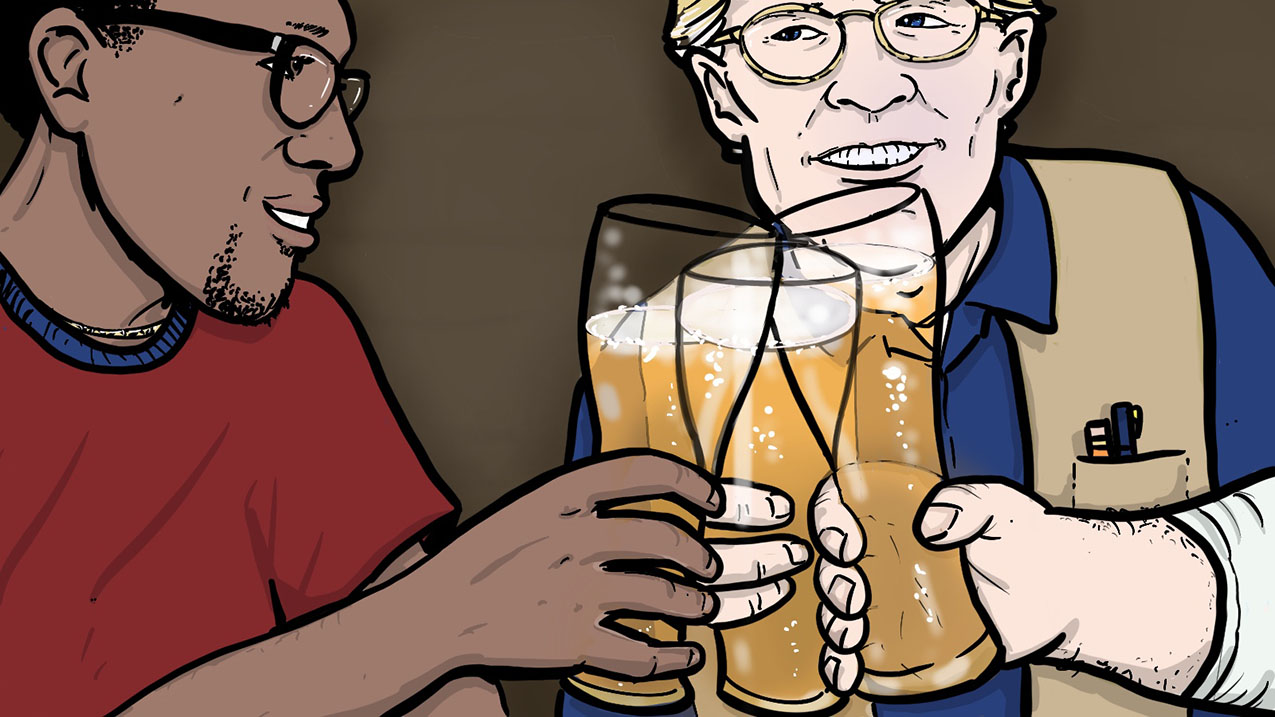
That lunch conversation with Matt hammered home how much our DesignShop participants appreciate the appeal of good live scribing. It’s the same reason sports and concerts capture spectators: scribing is imaginative, unscripted, improvisational, and creative—all authentic human expressions. When you add all those elements to the fact that it helps people see connections between ideas and concepts based on their conversations (so really, audiences aren’t just spectators; they’re participants in the creative act), being generated live, is it any wonder it has spread worldwide since MG Taylor's partnership with a big consulting firm in 1995? Which takes me back to my opening about genAI and why I am agnostic about it supplanting the human desire to experience authentic creativity.
Keep the humanity in the humanities
In the past few months, discomfort with genAI has grown, mostly among young people. A recent Pew Research survey showed that excitement about AI was declining across all age groups, but it was most pronounced among people under 30; 55% said they were more concerned than excited. Their worries stem from several factors, including a lack of trust in tech leadership, job loss, and declining creativity. That last one, a worry about declining creativity, shows just how appreciative and deeply invested people are in participating in authentic creative processes. Predictive AI may be useful in scientific research, but when it comes to artistic pursuits like writing, visual art, and music creation, genAI can only produce a facsimile of human experience. Generative AI's output is a homogenized, soulless replica built on the largely nonconsensual appropriation of human creativity. A perfect example of this is seen in the clips and short videos produced by genAI apps fabricating big Hollywood film productions (that viral fight featuring “Tom Cruise” and “Brad Pitt” comes to mind). On the surface, these things may look slick, but there’s a coldness to them. They fail at one of graphic recording’s basic responsibilities: being inspirational.
Graphic Recorders know that beyond capturing the facts, their work can inspire groups by illustrating metaphors and allegorical stories participants share during strategy sessions. Finding the best way to bring those things to life isn't just about adding an image to the text; it's also about knowing what will resonate with attendees. For instance, a comment may be made in jest, but it can hit on a deeper, uncomfortable truth that reveals its importance (see my previous Insight). Knowing what to scribe and how to depict it requires capturing what is spoken and the equally critical unspoken cues—like mood and the room's vibe—uniquely human traits that generative AI can't easily quantify
Vibe coding? How about vibe scribing!
According to GitHub, “Vibe coding is an AI-assisted way to code using plain language prompts, allowing developers to build software faster and think more freely.” Computer scientist Andrej Karpathy coined the term in 2025 to describe how non-technical people could create software by writing natural-language prompts that let the LLM handle the technical side of coding. This lets the prompter focus on the big picture, iterate rapidly, and stay in a creative flow by “vibing” with the AI assistant.
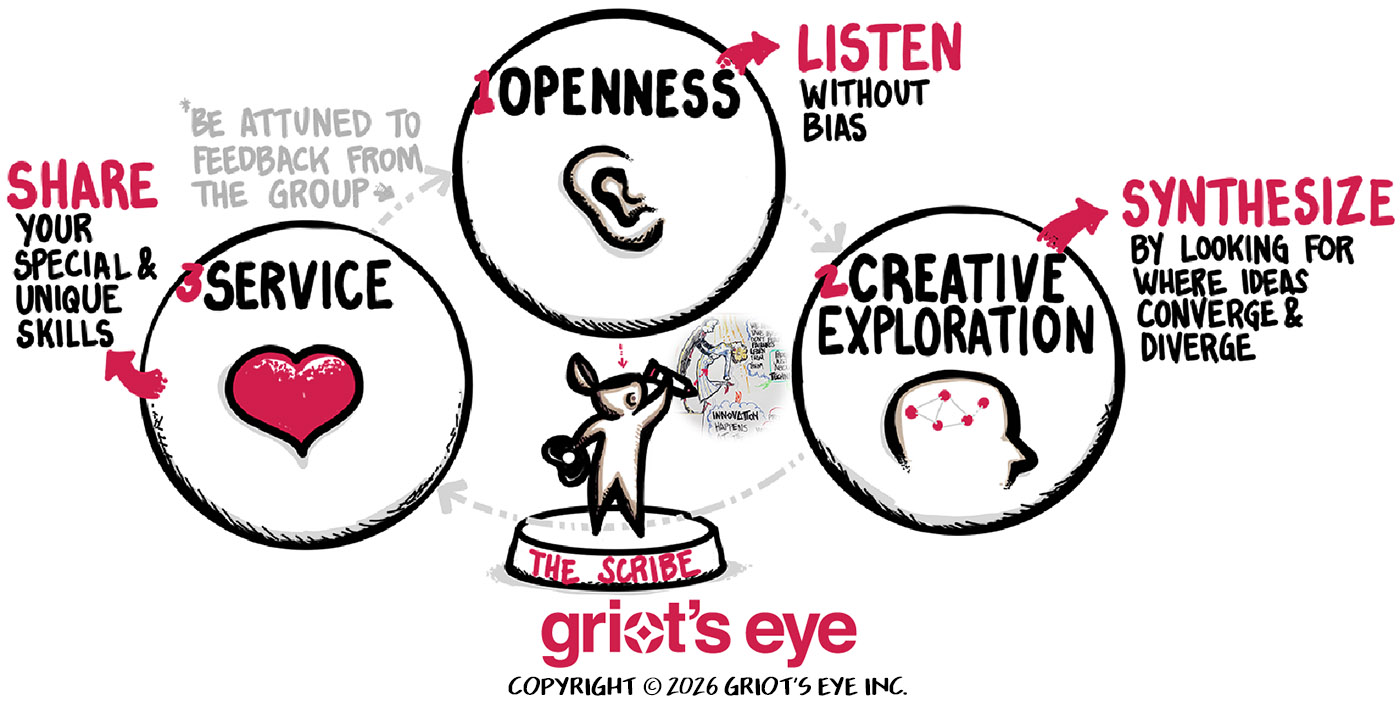
Creating using plain language, iterating rapidly, staying in the creative flow, and feeling the vibe sounds like what graphic facilitators have been doing since it first began in the Bay Area in the early 1970s (thank you Godfather). But in this case, rather than producing software, our goal is to capture that vibe and create a visual story in real time using plain language and often plain pictures. Over my career (almost 35 years now), I've found that capturing the event's vibe is one of the most important things your graphic recording must reflect. First and foremost, knowing the event’s vibe starts with empathy. Having an empathetic mindset as a graphic recorder means you should think of yourself not as an outside consultant, but as a member of your client’s team, albeit a member who has developed some special graphic skills that you will share with them to assist them in telling their story. I believe graphic facilitators should follow Three Simple Mindset Principles to keep them focused and empathetic: 1) Openness (listening without bias), 2) Creative exploration (looking for where ideas converge and diverge), and 3) Service (sharing your special skills). It is also critical to speak with your client before the engagement to get their perspective on: 1) the meeting’s goals and objectives, 2) what is in scope and out of scope, 3) potential contentious issues, and 4) their expectations of what the vibe will be when walking into the room on day one. Knowing all that and adhering to those mindset principles will set you up for success.
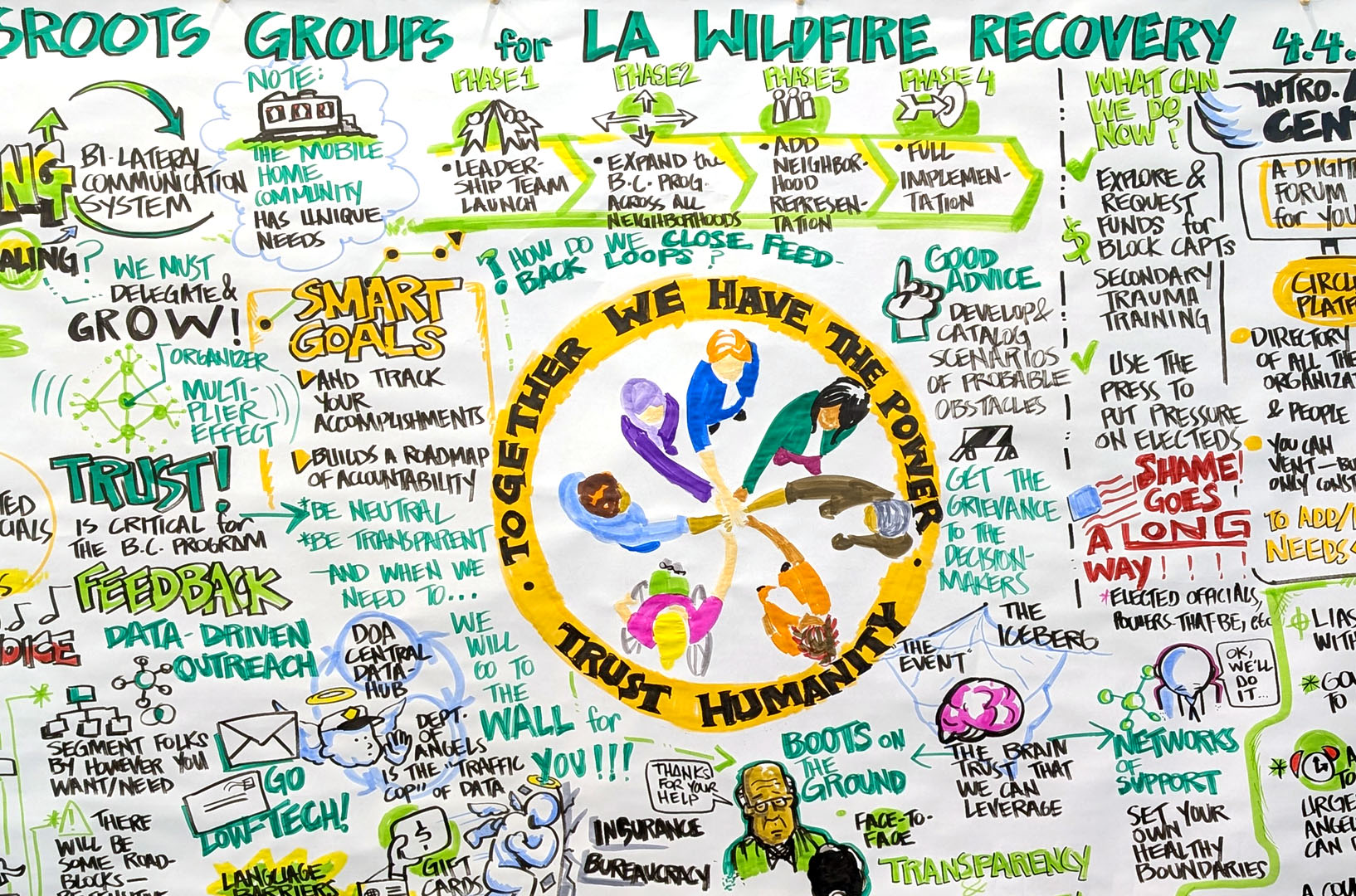
The graphic recordings below show how scribing can look very different depending on how you read the vibes
1) Grassroots Groups for LA Wildfire Recovery—a vibe of togetherness, trust, and new growth, signaled by the use of the color green. I used red sparingly because it was right after the fires, and I thought it felt inappropriate given its use in fire imagery. So I used red only a few times, specifically to highlight the powerful idea of using “shame” to pressure slow-moving officials. The graphic has a central focal point that I lightly pre-scribed in pencil before the meeting, showing figures placing their hands in a communal circle. The idea came from the prep call with the organizers, who wanted to highlight the need for diverse groups of ordinary citizens to work together. I saved a little room around the figures for any key messages that would come out of the discussion. I don’t often pre-scribe things, but this was a short meeting, and I wanted to ensure my "live performance" had a finished look for the finale. The final message that I added came from the attendees: “Together We Have The Power. Trust Humanity.” It was a simple, powerful statement by the participants that summed up the vibe that day. In case you don’t think attendees closely examine your work, after the meeting finished, one participant (a total-loss survivor) said she noticed I didn’t use much red and asked if that was because of its association with fire. I told her she was correct. She then thanked me, holding back a tear. It caught me off guard, and suddenly my eyes welled up a little too. Empathy is a key trait of good scribes everywhere. Remember, you're not just an outside consultant, you are a member of the team.
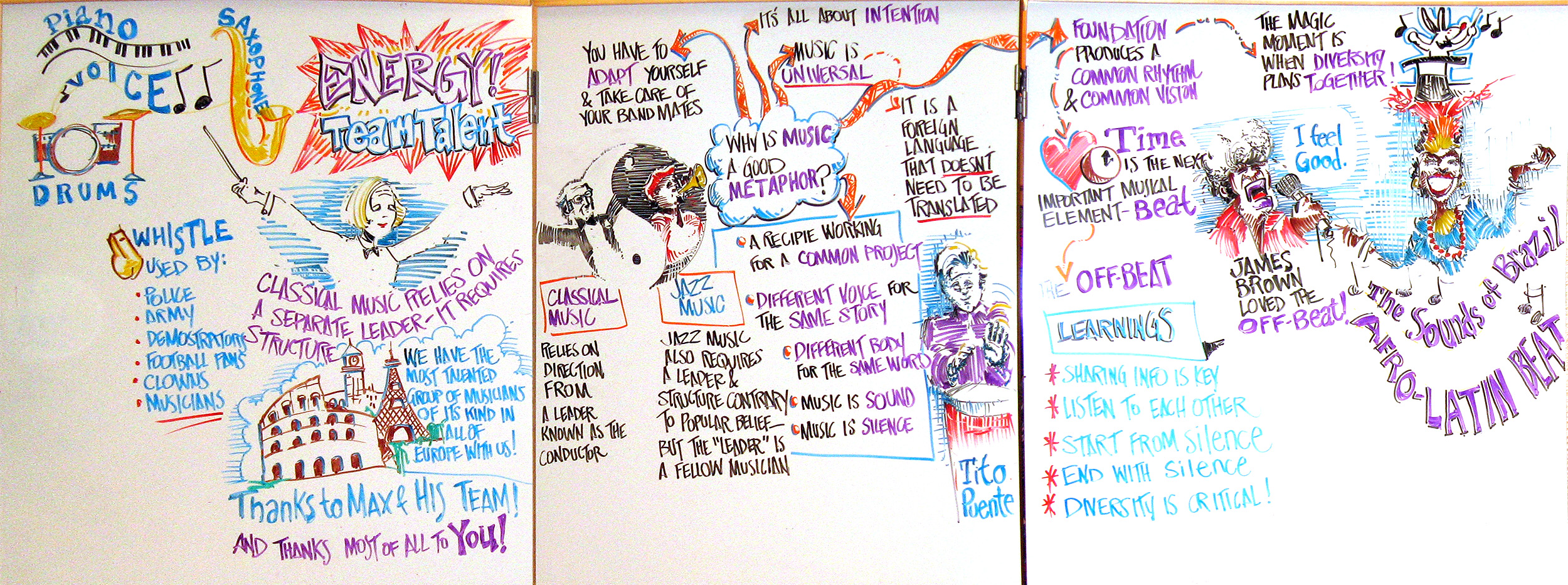
2) Music As A Metaphor—the vibe here is rhythmic (notice the use of wavy lettering), joyful, and energetic. The audience was mostly young people starting their careers in business, so the energy was high. This graphic recording captured a presentation that was given in Italy by a group of musicians who spoke to young managers about how music, especially classical and jazz, can be a metaphor for the thinking they needed at their company, in this case, balancing structure and improvisation. The yin and yang symbol showing the complementary nature of classical and jazz music grew out of the speaker's description. It is highly illustrative (even for me) because that was a fun session where the musicians played live while I scribed beside them. The kids wanted a show (an authentic one), and by god, we gave it to them. I have scribed on many different surfaces, like paper, foam core boards, and the iPad. But to this day, my favorite medium is dry erase because that’s the surface I “grew up on” at MG Taylor (some would say, matriculated), and I'm as “fast as my thoughts” on a dry erase wall. People ask me if I get upset that the work gets erased. But I have grown to love that aspect because it makes it like tending a zen garden. You make all these beautiful marks and patterns, then wipe them away to create something new. Also, young folks today have digital distractions, but my first creative love was Etch A Sketch, so wiping away drawings feels nostalgic. Anyway, we ended up receiving a big ovation; talk about good vibrations. Bravissimo!
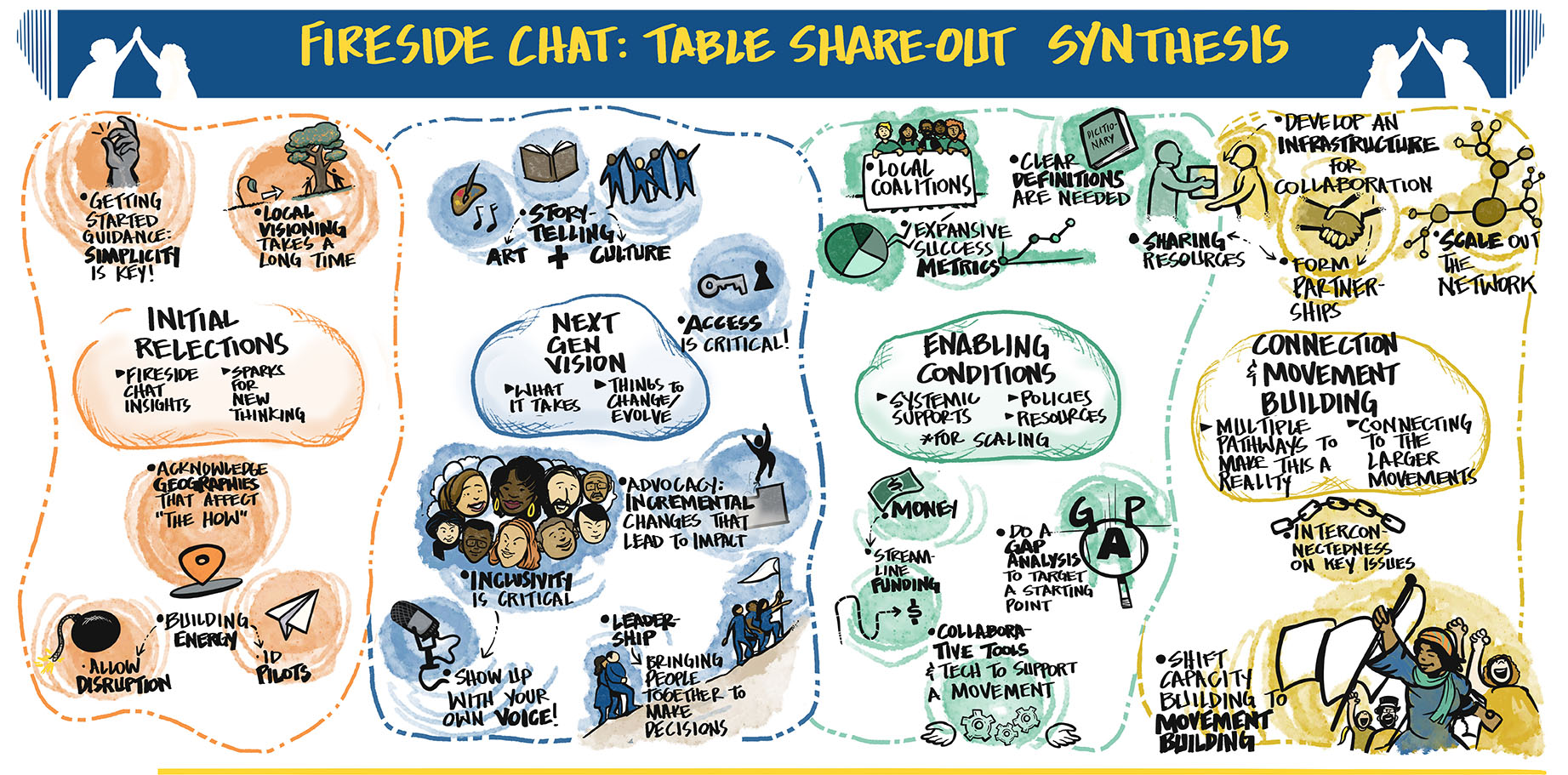
3) Fireside Chat Synthesis (digital scribe)—the vibe here is uplifting, advice-giving. It was for a relatively short fireside chat, filled with quick bits of useful wisdom the panelists wanted to share with attendees. For me, digital scribing on an iPad has plusses (the end product is clean) and minuses (the drawing surface is small, and for me, it’s not as fast as making marks on paper), so my work isn’t quite as real-time when it comes to “looking pretty.” So here I captured the content live, but took advantage of the iPad’s ability to make post-editing easier. In post, I differentiated the four topics clearly by color. To inspire people, the bottom-right image is based on French artist Eugène Delacroix’s “Liberty Leading the People.” Like a DJ digging through crates, I have interpolated that image countless times during my career—like below. One day, I vow to go “full French” (if the vibe allows it) and scribe Liberty with her ripped bodice. Oh là là!

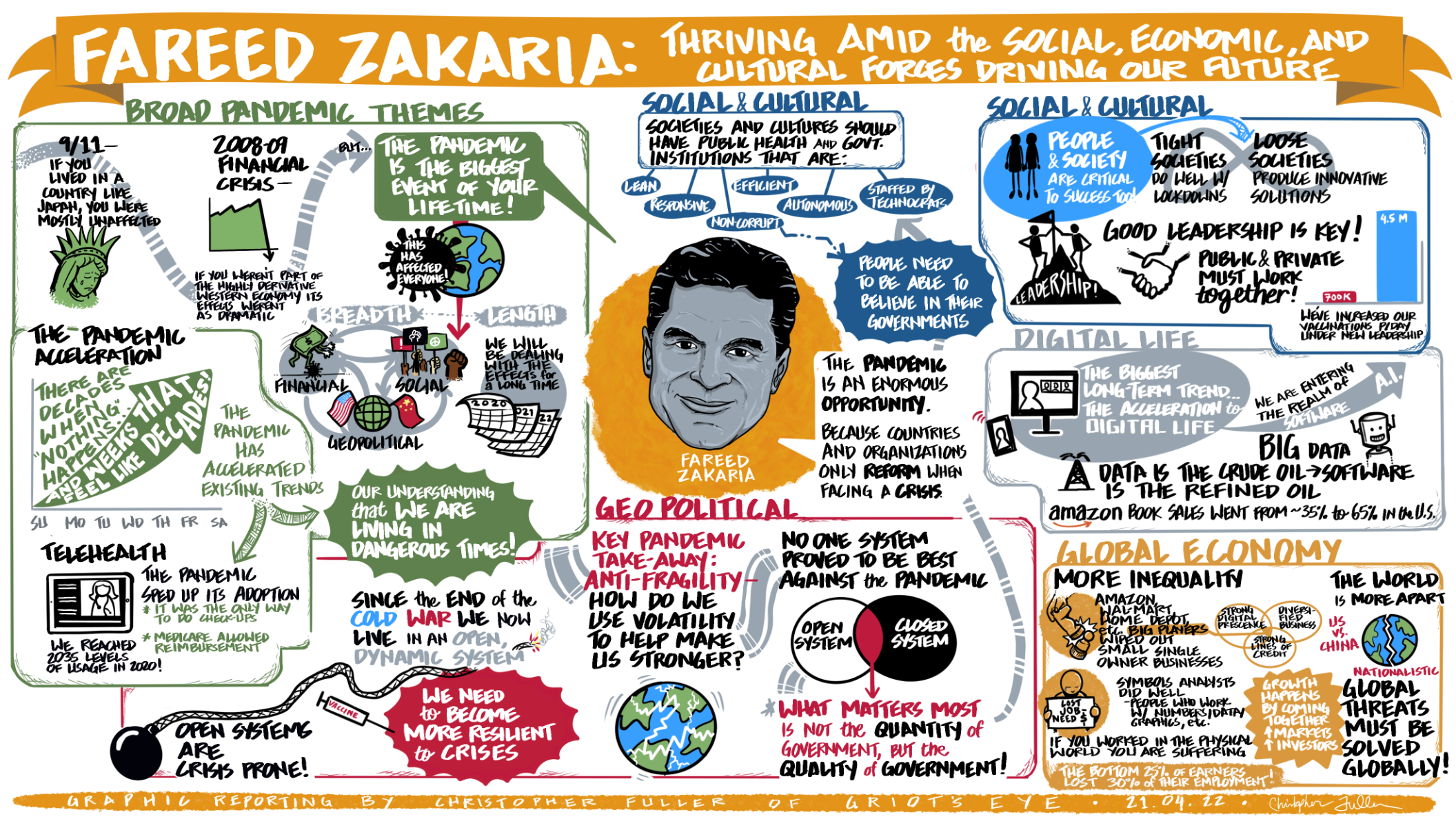
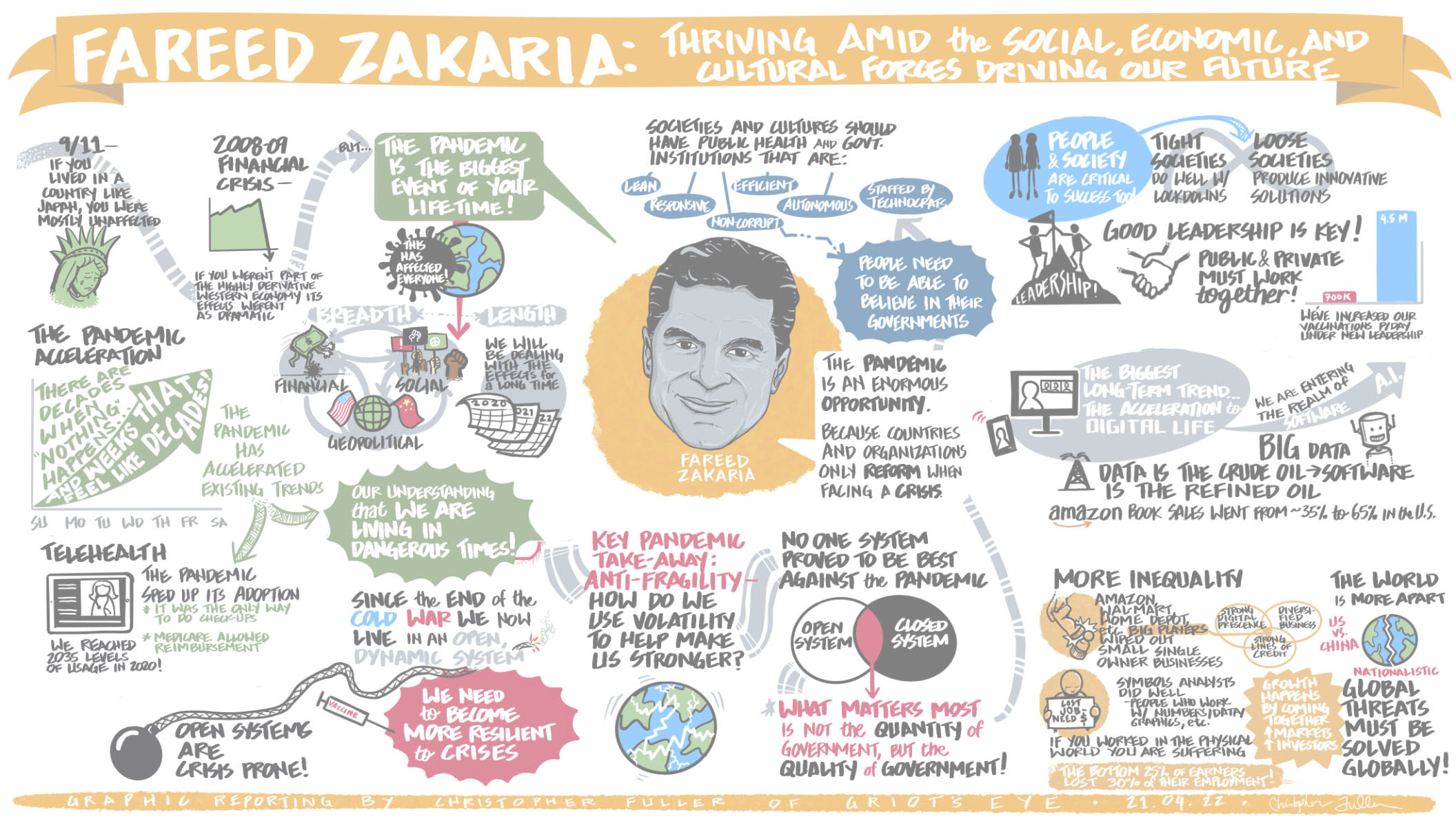
4) Fareed Zakaria Keynote (digital scribe)—the vibe here is information-rich, technically dense, and reflective of our digital landscape. I created this graphic record for a virtual keynote by journalist, political commentator, and author Fareed Zakaria, delivered to a top consulting firm. Fareed shared a lot of information in a relatively short time, so it wasn’t easy to assemble in real time. To lighten the burden, I pre-scribed Fareed’s likeness beforehand because there’s no way I could draw it in real time while still keeping up with my chief responsibility: being a reporter. In Fareed’s keynote, he shared many thoughts and predictions about the social, economic, and cultural forces shaping our post-Pandemic future. Because scribing is unscripted and we work “without a net” beyond a basic layout idea (in this case, using Fareed’s face as the central image), a scribe doesn’t have time to design the way a graphic designer would for an ad or poster. So during the presentation, I would mark out subject changes with frames, color relationships, and titles and subheaders I thought of. I then used the post to strengthen those identifiers so that the information would be more digestible in data chunks for the viewer. These graphic identifiers are part of what I call The Six Storytelling Fundamentals of Graphic Reporting: 1) Annotation—text reporting; 2) Actors—drawings, icons, symbols, etc.; 3) Frames—bordering similar subject matter; 4) Relationships—using things like lines, arrows, connectors, and color to show the convergence and divergence of ideas; 5) Titles and Subheaders—different from the normal annotation reporting, this text is usually bigger, bolder, and colorful to call out major topic areas; and 6) Placement and Flow—though graphic recorders cannot be as precise as a graphic designer in the moment (after all design, is about planning and iteration) you can make crucial decisions regarding how your information is read simply by where you write things down to show how one topic flows into the other. If you remove the storytelling fundamentals, especially the frames, color relationships, and titles and subheaders from this graphic record, due to the density of its information, it would be harder to decipher.

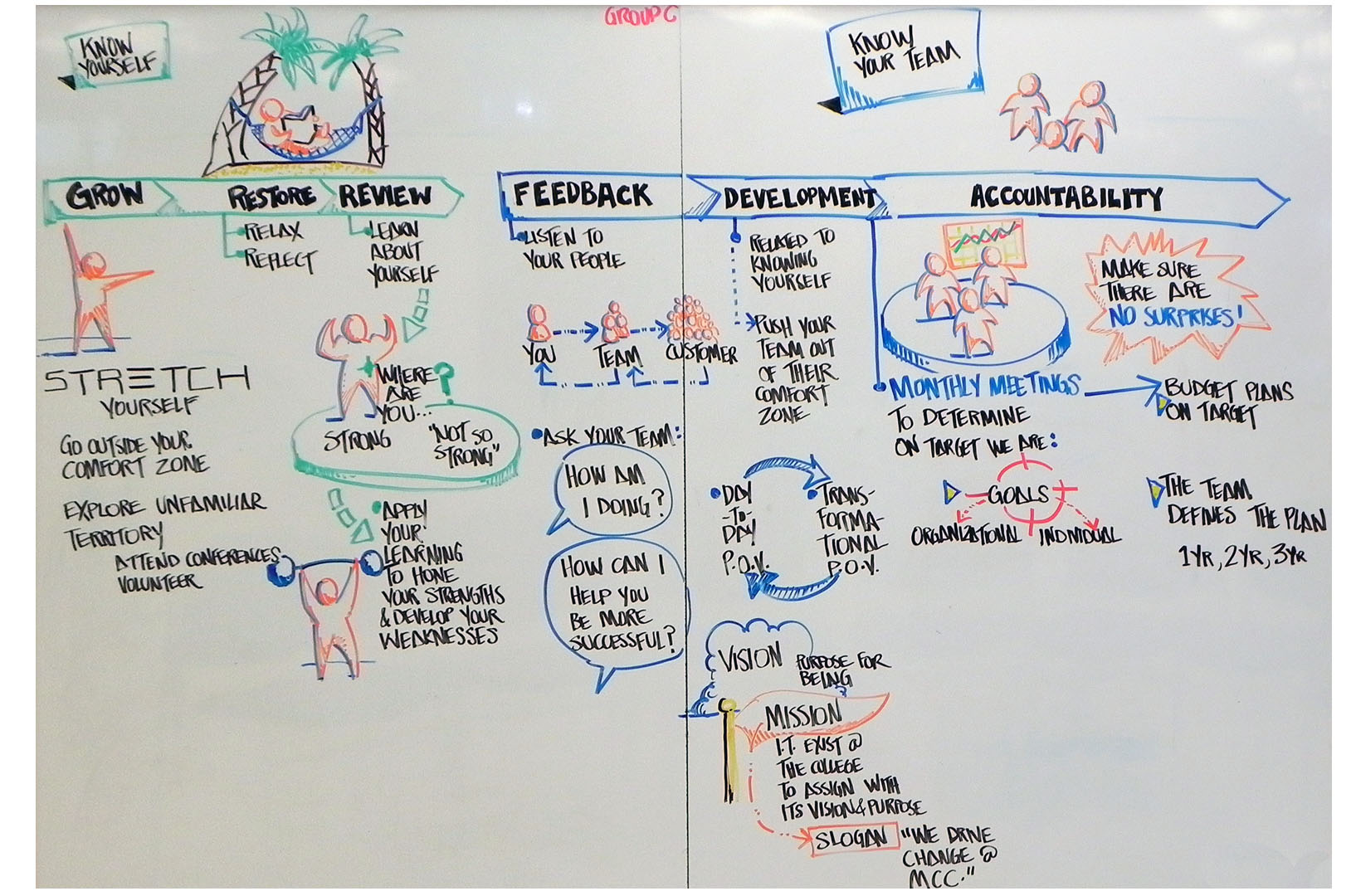
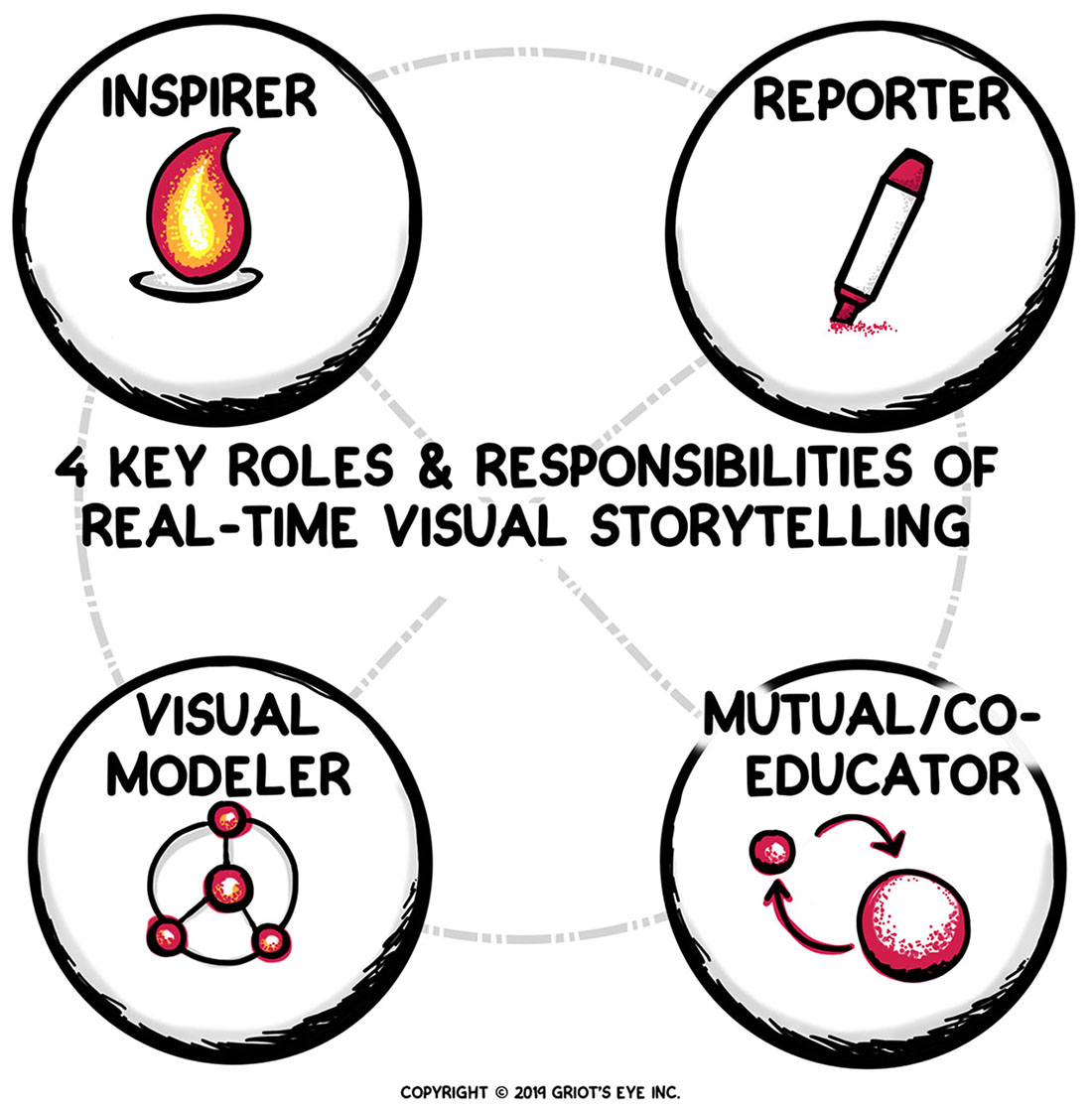
5) Know Yourself/Know Your Team Report-Out—this graphic record was captured live during a team report-out at a strategy session. Just like the report-out, its vibe is simple, clean, and to the point. You’ll notice the drawings here are simpler than the highly illustrative (“show-offy”) nature of my other work (especially compared to the Music As A Metaphor scribing done in Italy). That was because this was a corporate session with a repeat client who'd seen my work many times before, and what they needed from me had less to do with inspiration and more to do with me being a reporter. I maintain that in real-time visual storytelling, there are Four Key Roles and Responsibilities of Real-time Visual Storytelling that scribes must possess: 1) Reporter, 2) Mutual/Co-Educator, 3) Visual Modeler, and 4) Inspirer. This graphic leans heavily on my reporting and visual modeling skills. The reporting mixes text with very simple drawings rather than cartoon likenesses. I use this style a lot when I create models like the process flows here for universality.
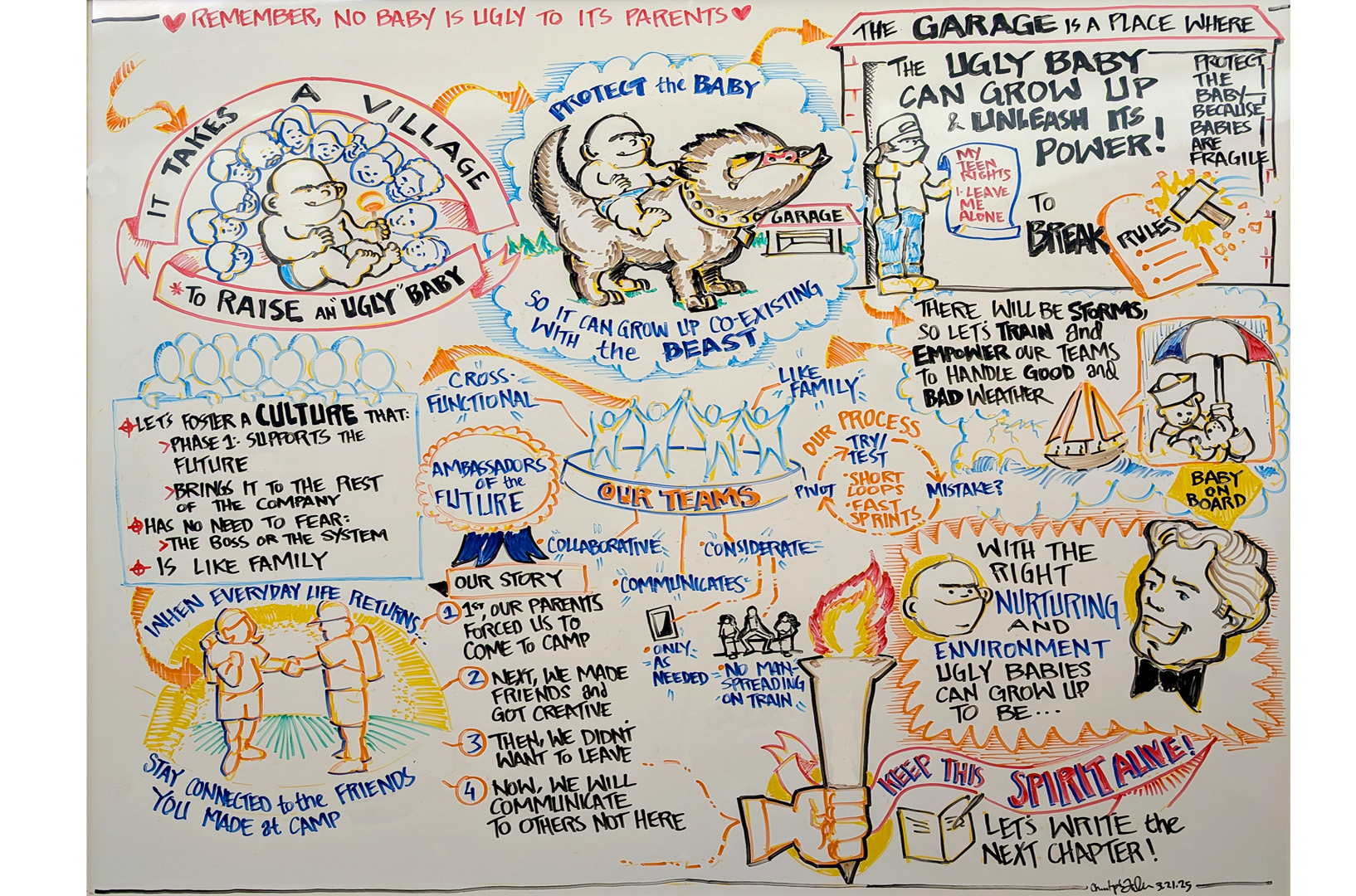
6) The Ugly Baby—the old MG Taylor axiom can sum up the vibe here: “If you can’t have fun with the problem, you will never solve it.” The concept of “the ugly baby” comes from renowned Pixar designer Ed Catmull in his book, “Creativity, Inc.: Overcoming the Unseen Forces That Stand in the Way of Inspiration.” The idea is that organizations often abandon projects early because the initial reception was poor. The ugly baby gets rejected by its parents, when perhaps with continued ideation, prototyping, and testing, that ugly baby has a chance to grow up to be something beautiful. I created this graphic record for a top manufacturing company overseas that was looking to adapt the ugly baby concept to their company and create an in-house research and development division for new concepts—a skunkworks/ugly baby incubator. Though the subject matter was serious, the participants in the room that day took the ugly baby metaphor to heart and had a lot of fun with it. That fun, jocular spirit was like a double shot of espresso, infusing their conversations with creativity and laughter. It was a successful event, and I’m not sure who enjoyed the metaphor more: me or the strategy session attendees.
Don’t let convenience be your undoing
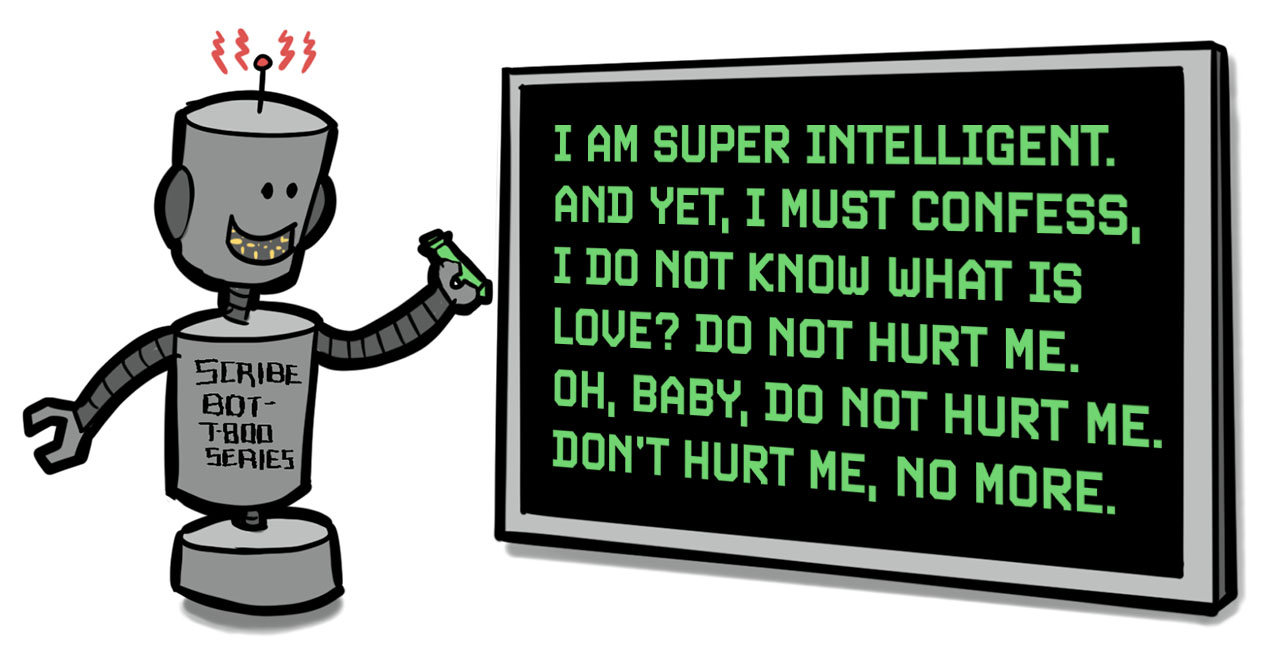
So, I’ve written a lot of thoughts about generative AI versus authentic human expression, imagination, the unquantifiable empathetic human ability to read vibes, and the wonder of authentically crafted creative works rendered live and in person. And I’ve shared my agnosticism toward the former, while expressing my deep love and appreciation for the latter, and you may be wondering why—after all, AI hasn’t encroached on the live graphic recording world. The Robo-Scribe, aka Scribe-Bot T-800 series, is still years away (I’m convinced that will cue the end of late-stage capitalism). But you don’t have to be Nostradamus to see where the future could be headed if we don’t “chickity-check” ourselves before we wreck ourselves all in the pursuit of efficiency, convenience, and consolidation of power at the top. My apologies to Das FX and Ice Cube for biting that line, but after Ice Cube starred in one of the worst films of all time, The War of the Worlds remake, which I’m certain had its script produced by genAI prompts, I figure I’m owed one (okay, I hate-watched it, but still…painful). And anyway, unlike generative AI, I don’t take work without properly attributing creators, because that would be stealing.
As someone who's considered himself creative his whole life and has worked hard to hone his skills, I love the journey of creation as much, if not more, than the product. At the start of this Insight, I mentioned how much people enjoy seeing authentic live performances by athletes, musicians, and dancers. But it’s not just seeing the results that gets us jazzed up; it’s also understanding that performers had to dedicate an insane number of hours to reach that level. It’s a mix of practice and play, diligent hard work, and joyful exploration that makes high-level performance seem effortless. My family will attest that I can render a lot of simple drawings quickly now because I spent countless hours drawing as a kid. (They would probably also tell you I did this at the expense of other social skills, but alas, here we are). But the journey along the way is filled with so much wonder, self-discovery, and mistakes- the human stuff that I believe makes us special- that I wouldn’t want it any other way. If it were too convenient, it wouldn’t be worth doing for true artists. I learned how to draw by making mistakes. If you already know how to write, make art, design, etc., you may find generative AI a useful tool. But for younger generations, the ones still learning, how will they develop on their own if they surrender critical thinking and decision-making to machines?
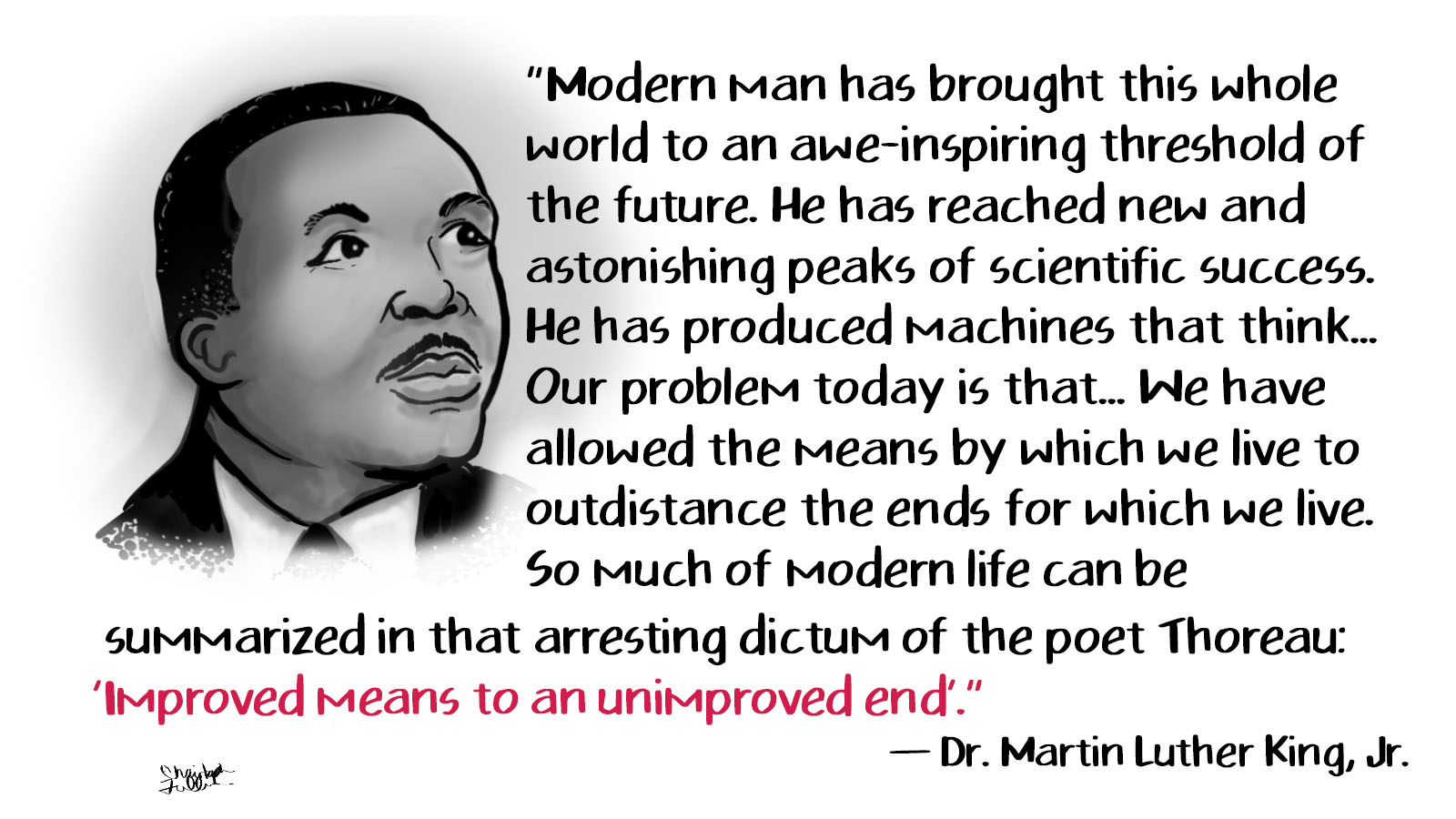
Maybe this new generative AI age is inevitable, and I, my fellow artists, art appreciators, and craftspeople, will be pushed aside as hyperscale data centers continue to spread (whether society wants them or not), genAI steals ideas, and fewer and fewer tech companies consolidate the artistic labor at the top of the chain. Pushed aside to make room for the machines, like American folk hero John Henry, the Black freedman known as The Steel Driving Man who lost out to the steam engine at the dawn of the Industrial Age. If so, consider my markers my hammer, and I will keep hammering on—until I have to make way for the Scribe Bot (if someone takes a hammer to it, I swear it wasn’t me). Finally, I’d like to end this Insight with this excerpt from Dr. Martin Luther King Jr.’s Nobel Laureate acceptance speech on December 11, 1964:
“Modern man has brought this whole world to an awe-inspiring threshold of the future. He has reached new and astonishing peaks of scientific success. He has produced machines that think….This is a dazzling picture of modern man’s scientific and technological progress. Yet, in spite of these spectacular strides in science and technology, and still unlimited ones to come, something basic is missing. There is a sort of poverty of the spirit which stands in glaring contrast to our scientific and technological abundance. The richer we have become materially, the poorer we have become morally and spiritually… Every man lives in two realms, the internal and the external. The internal is that realm of spiritual ends expressed in art, literature, morals, and religion. The external is that complex of devices, techniques, mechanisms, and instrumentalities by means of which we live. Our problem today is that we have allowed the internal to become lost in the external. We have allowed the means by which we live to outdistance the ends for which we live. So much of modern life can be summarized in that arresting dictum of the poet Thoreau: ‘Improved means to an unimproved end’.” — Dr. Martin Luther King, Jr.
Show your appreciation for authentic human experience, intelligence, and imagination by supporting Griot’s Eye
Would you like to distinguish your next event by incorporating the authentic human experience of live graphic recording and artistry that signals to your participants that your meeting is going to be different, creative, and fun in a way that values their human experience? Are you interested in learning how to use graphic recording skills in your business and personal life to create visually engaging journals, document team meetings, or support your visioning? Are you a creative person interested in learning the growing craft of graphic recording because you know people will always value authenticity and human-made art? Would you be interested in learning graphic recording techniques from someone with almost 35 years of professional graphic facilitation experience — the first person to bring the craft to Europe (1997) and Asia (1999), backed by a billion-dollar consulting firm? Then sign up for our mailing list. Please select the “classes” section if you’re interested in a workshop; that way I can gauge interest in when and where to host the next in-person session.
Graphic recording historical trivia: How the MG Taylor branch of the graphic recording tree planted seeds overseas
After writing a lot about the nature of intelligence and how graphic recorders can tell imaginative stories just by listening and reading vibes, I will end with a short story about how I nearly dismissed the opportunity to be the first person to scribe in Europe, backed by a big consulting firm. A nearly epic self-own that doesn’t speak well of my intelligence or my ability to read vibes back then, but alas, here we are. Anyway, it was 1997, and I was having lunch with our new hire at MG Taylor, Jay Smethurst, at our headquarters in Hilton Head, SC, when Patsy Kahoe, who worked at MGT overseeing all the logistics, came over to alert me that Ernst & Young would be opening their first overseas facility in Luton, England, and specifically requested that I scribe their inaugural session to introduce the craft. I told her to tell them no, and she repeated the question because she realized I was making a knucklehead decision. I said no again. Then she told me to think about it and walked away (Patsy's a helluva lot smarter than I am). Jay asked why I didn’t want to go. I confessed I had never flown over the ocean and the thought of it scared the hell out of me. Jay told me that I’d be missing out on the potential “glory” of being the first person to scribe in Europe. He added that, if God forbid, the plane crashed into the Atlantic on the way there or back, then I would “go out in a blaze of glory.” So either way, I was set for glory, and it was a win-win situation! So I ran back to catch Patsy and tell her I changed my mind to yes. From that event in September 1997, we planted a graphic recording seed in England that I have since watched blossom worldwide, thanks to the massive reach of big consulting firms and their association with MG Taylor Corporation (MGT is gone, but the legacy lives on!). And over a million flight miles and three decades later, I’m still using my authenticity, intelligence, imagination, and ability to read vibes to tell stories visually in real-time. I am going to keep on swinging that hammer, um, I mean marker.